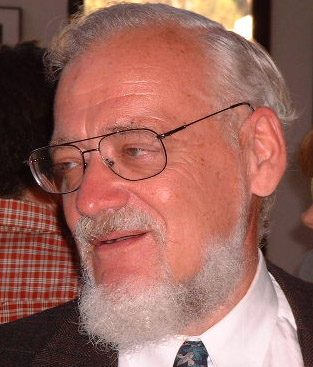
b. 1938
Brian Skyrms is an American philosopher of science known for his work on the evolution of social norms, game theory, probability, and inductive logic. He has made significant contributions to understanding how cooperation, signaling, and conventions can emerge through evolutionary dynamics without rational deliberation.
Developed evolutionary game-theoretic models of social contract formation in 'Evolution of the Social Contract'
Pioneered work on the evolution of signaling systems in 'Signals: Evolution, Learning, and Information'
Advanced understanding of dynamic deliberation and the foundations of Bayesian reasoning
Contributed to formal epistemology through work on probability, coherence, and conditionalization
Distinguished Professor at UC Irvine and Professor of Philosophy at Stanford University
The inference from premises (1)-(3) to the conclusion that grammar G is unlearnable from the pld (period) involves an equivocation
claimThe principle of maximum entropy is a more cautious and broadly applicable version of the Principle of Indifference.
claimPlausibility updates in sequential games during actual play differ in interpretation from plausibility updates used in pregame deliberation for Backward Induction.
claimBackward induction is self-undermining as a solution concept in certain extensive-form games
The replicator dynamics need not converge to an evolutionarily stable state.
claimThe principle of maximum entropy is a more cautious and broadly applicable version of the Principle of Indifference.
claimPlausibility updates in sequential games during actual play differ in interpretation from plausibility updates used in pregame deliberation for Backward Induction.
claimBackward induction is self-undermining as a solution concept in certain extensive-form games
A loss in one respect may be outweighed by a benefit in another
premiseAdvantages not expressible in monetary terms can still be rationally decisive
premiseApproaching the truth faster—assigning probability above a threshold to the true hypothesis more quickly—is an advantage that should factor into choosing an inference rule
premiseApproaching the truth faster (assigning high probability to the true hypothesis more quickly) is a benefit not readily expressed in monetary terms but should be taken into account when choosing an inference rule
A probabilistic version of abduction may perform better than Bayes' rule in our world by approaching the truth faster
claimProbabilistic abduction may be preferable to Bayes' rule as an inference rule
premiseProbabilistic abduction approaches the truth faster than Bayes' rule on average in our world