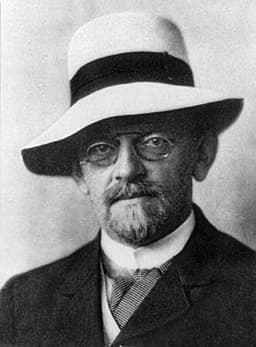
David Hilbert
modernFormalism, Mathematical Logic, Philosophy of Mathematics1862 – 1943
David Hilbert (1862–1943) was a German mathematician widely regarded as one of the most influential mathematicians of the 19th and 20th centuries. He made foundational contributions to algebra, functional analysis, mathematical physics, and the philosophy of mathematics, most notably through his formalist program seeking to ground all of mathematics in a complete and consistent axiomatic system. His 1900 list of 23 unsolved problems shaped the trajectory of 20th-century mathematics.
Notable Achievements
1
Proposed Hilbert's Program: the formalist project to axiomatize all of mathematics and prove its consistency via finitary methods
2
Published 23 open problems in 1900 that defined the research agenda for 20th-century mathematics
3
Developed Hilbert spaces, foundational to functional analysis and quantum mechanics
4
Contributed to the axiomatization of Euclidean geometry in Grundlagen der Geometrie (1899)
5
Made independent contributions to the field equations of general relativity alongside Einstein