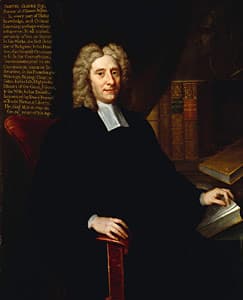
Samuel Clarke
modernBritish Rationalism / Natural Theology1675 – 1729
Samuel Clarke (1675–1729) was an English rationalist philosopher and Anglican clergyman who made significant contributions to natural theology, moral philosophy, and the philosophy of space and time. He is best known for his a priori cosmological argument for God's existence, his rationalist metaethics grounded in eternal moral truths, and his celebrated correspondence with Gottfried Wilhelm Leibniz defending Newtonian absolute space and time.
Notable Achievements
1
Developed an influential a priori cosmological argument in 'A Demonstration of the Being and Attributes of God' (1705)
2
Conducted the Leibniz-Clarke Correspondence (1715–16), defending Newtonian physics against Leibnizian relational space-time
3
Articulated a rationalist moral philosophy grounding ethics in eternal, necessary relations of fitness independent of divine will
4
Translated Newton's 'Opticks' into Latin and served as a key interpreter and defender of Newtonian science
5
Delivered the Boyle Lectures (1704–05), setting a template for rationalist natural theology in the eighteenth century