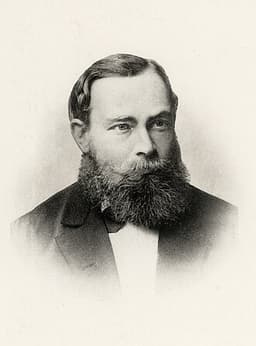
1848 – 1925
Gottlob Frege (1848-1925) was a German mathematician, logician, and philosopher widely regarded as the founder of modern logic and analytic philosophy. His development of predicate logic and his work on the philosophy of language and mathematics fundamentally transformed both fields, influencing Russell, Wittgenstein, and Carnap.
Developed modern predicate logic in the Begriffsschrift (1879)
Established the sense/reference (Sinn/Bedeutung) distinction in philosophy of language
Pioneered logicism, the view that mathematics reduces to logic
Authored Die Grundlagen der Arithmetik, foundational for philosophy of mathematics
Laid the groundwork for analytic philosophy as a tradition
By analogy, simply positing relational tropes does not provide an effective theoretical response to Bradley's argument
claimThe hermeneutical experience of truth is not a blind acceptance of the authority of tradition
claimWe must distinguish between the radical empiricist's meaning of 'meaning' (epistemic reduction) and a more common-sensical meaning of 'meaning' (factual reference).
claimMetric geometry is neither true nor false.
claimThe truth of a proposition in a world does not entail that the proposition exists in that world
claimThe semantics of a formal system rich enough to contain elementary mathematics cannot be fully defined in terms of mathematical functions within that same system.
We must distinguish between the radical empiricist's meaning of 'meaning' (epistemic reduction) and a more common-sensical meaning of 'meaning' (factual reference).
claimThe shared denotation of sentences (1) and (5) cannot be the propositions expressed by each sentence
claimThe semantics of a formal system rich enough to contain elementary mathematics cannot be fully defined in terms of mathematical functions within that same system.